

What is a sonic logging pipe?
Sonic logging pipes, also known as ultrasonic testing pipes, consist of four parts: a top pipe, a middle pipe, a bottom pipe, and a wooden plug (or pipe cap). They are manufactured by directly processing straight seam welded pipes, with the appropriate joint welded to one end of the pipe.Different connectors correspond to different connection methods and will have different names. Examples include: crimp-type sonic logging pipe, spiral sonic logging pipe, sleeve-type sonic logging pipe, and socket-type sonic logging pip
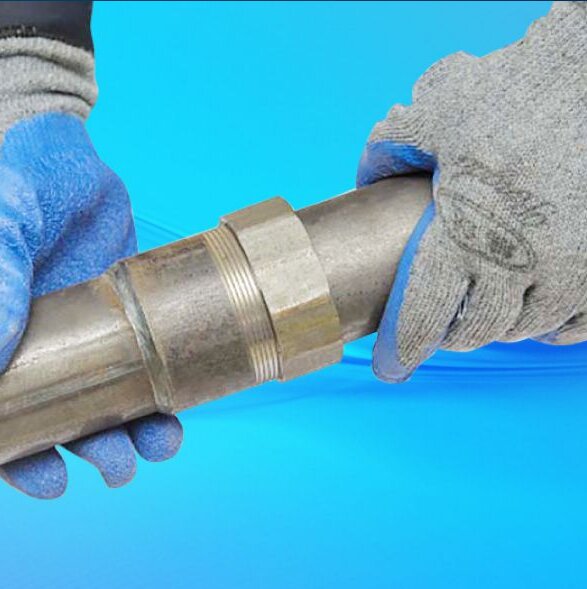
1. Characteristics and comparison of different types of acoustic logging tubes
Crimped sonic logging pipes are currently the most widely used type in domestic construction engineering. The connection principle is as follows: The joint has a groove containing a rubber sealing ring. After inserting the pipe, a special hydraulic clamp is used to align with the groove and press, causing the steel pipe to deform and lock the joint.
Advantages:
Extremely fast installation: Single-section connection takes only a few seconds.
Low cost: The pipe wall thickness is usually thin (1.0mm - 2.0mm), resulting in low material costs.
Safety: No welding required, no fire hazard.
Disadvantages:
Weak tensile strength: May pull out under excessive force; not recommended for ultra-deep piles (e.g., exceeding 60 meters).
Tool dependency: Requires a special hydraulic clamp.
Applicable scenarios: Conventional pile foundations for ordinary bridges and high-rise buildings.
2. Spiral Sonic Logging Pipe
Connection Principle: The connector has precision threads (threads) at both ends. The two pipes are tightened by either using a locking nut in the center or by directly screwing them in opposite directions.
Advantages:
High Connection Strength: Extremely strong physical connection with excellent tensile and torsional resistance.
Excellent Sealing: Double seal, virtually eliminating grout leakage.
Convenient Construction: Only a pipe wrench is needed for operation.
Disadvantages:
Higher Cost: Complex connector processing and typically thicker pipe walls (≥2.0mm).
Slightly Slower Speed: Tightening the threads takes longer than with a clamp-type connector.
Applicable Scenarios: Ultra-deep piles, railway piles, and key projects under complex geological conditions.
3. Sleeve-type sonic logging pipe
Connection principle: A sleeve with a slightly larger diameter is welded to one end of the pipe. The other end is inserted into the sleeve, and then circumferential welding is performed.
Advantages:
High rigidity: The welded joint has a strength close to that of the base material.
Simple materials: No complex mechanical joints are required.
Disadvantages:
Environmentally limited: Requires power supply and a professional welder on site.
Numerous potential hazards: Incomplete welding can lead to grout leakage; weld slag falling into the pipe can block the channel; high temperatures may burn plastic seals (if any).
Applicable scenarios: Currently, due to environmental protection and efficiency requirements, it is gradually being replaced by clamp-type and spiral-type pipes.
4. Socket-type sonic logging pipe
Connection principle: Utilizes spring clips or a simple plug-in structure to achieve "one-plug-and-lock" connection.
Advantages:
Fastest speed: Theoretically faster than clamp-type.
Tool-free: Sometimes no auxiliary tools are needed.
Disadvantages:
Sealing risk: Purely mechanical plug-in connections are prone to grout leakage without high-quality sealing rings.
Poor vibration resistance: Severe vibration during the lowering of the reinforcing cage may cause the joint to loosen.
Applicable scenarios: Temporary support piles or projects with less stringent testing requirements.
How to choose between different types of acoustic logging tubes?
Consider the pile depth: For piles less than 50 meters, choose the clamp-type pile; for piles longer than 50 meters or ultra-deep piles, choose the spiral type.
Consider the budget: For the best cost-performance ratio, choose the clamp-type pile.
Consider the specifications: If the supervisor explicitly prohibits on-site welding, exclude the sleeve type.
What is the function of a sonic logging tube?
Testing Pile Foundation Integrity: Using an ultrasonic logging tube, an ultrasonic probe is inserted deep into the pile foundation. By testing the propagation characteristics of ultrasonic waves in the pile foundation's concrete medium, the integrity of the pile foundation is determined. For example, it can detect problems such as broken piles, cracks, and concrete segregation. The sealing of the logging tube significantly affects the test results; therefore, high-precision ultrasonic testing instruments and professional technicians are required for operation.
Testing Pile Foundation Concrete Strength: The ultrasonic logging tube can also test the strength of the pile foundation concrete. By analyzing the propagation speed of sound waves in concrete, the compressive strength of the concrete can be calculated, thereby determining whether the pile foundation quality meets design requirements.
Testing the Thickness of Deposits at the Bottom of the Pile Foundation: After the completion of cast-in-place pile construction, sediment such as mud and sand may remain at the bottom. Using an ultrasonic logging tube, an ultrasonic probe can be placed at the bottom of the pile foundation. By measuring the distance between the sediment and the concrete interface, the thickness of the sediment can be calculated. If the sediment is too thick, it will affect the bearing capacity of the pile foundation, requiring cleaning or other remedial measures.
Detecting pile diameter: Using sonic logging tubes, ultrasonic probes can be placed inside the pile foundation. By moving the probes and recording the propagation time of sound waves at different locations within the pile, the pile diameter can be calculated. This method can be used to check whether the geometry of the pile foundation meets design requirements.
Providing construction guidance: During pile foundation construction, the results from sonic logging tubes can provide guidance. For example, if defects are detected inside the pile foundation, remedial measures can be taken promptly to avoid larger quality problems.
Providing a basis for structural design: During the building structural design phase, the results from sonic logging tubes can provide a basis for structural design. Based on the test results, designers can more accurately assess the bearing capacity and stability of the pile foundation, thereby optimizing the design scheme.

admin
No comments for this content